

LEARNING FOR LIFE

Our individualised approach nurtures your child’s academic and social growth, opening doors to lifelong success. From early childhood to Middle School, our curriculum lays a strong foundation and fosters global understanding to prepare your child for the future.

Our Academic Philosophy

Learning at Mirai begins with the child’s natural inclination to observe, question, and make meaning.

We honour this inner curiosity by designing academic experiences that:
Our Programmes

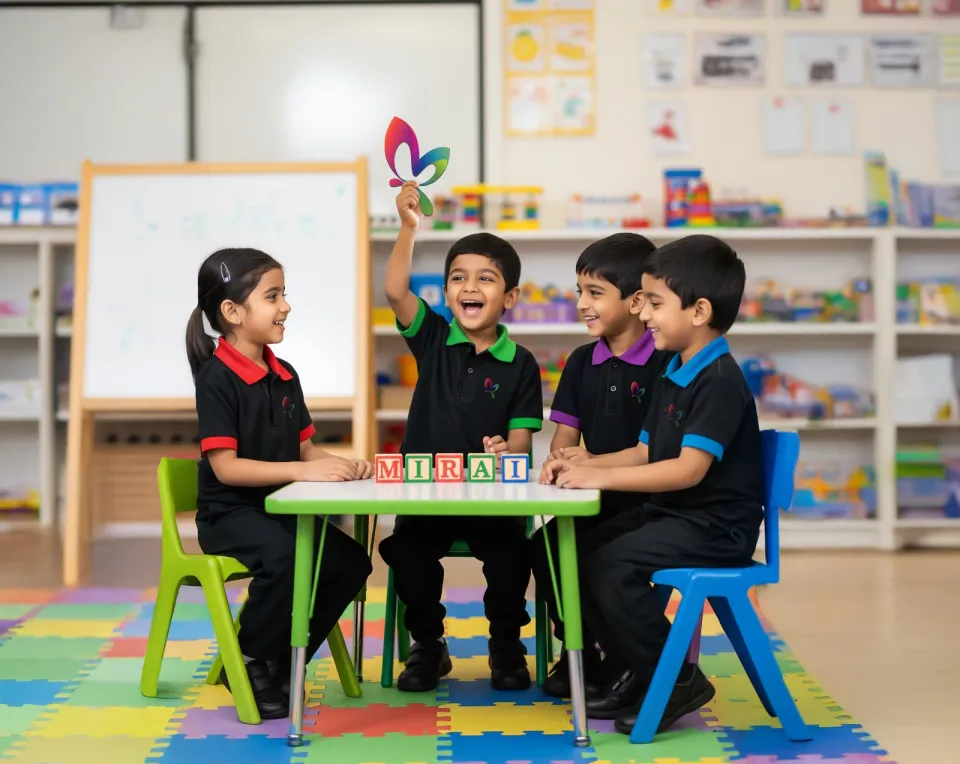
Foundational Stage

(Pre KG – Grade 2)

(Age 3 to 7)

  • Physical Development: Activities to improve gross and fine motor skills, coordination and overall physical health.
  • Cognitive Development: Building critical thinking, problem-solving and early numeracy skills through activities like puzzles and logical games.
  • Socio-Emotional Development: Developing social skills, emotional regulation, empathy and ethical values through group play and interaction.
  • Language and Literacy: Developing strong language skills, early reading and writing through stories, rhymes and conversations.
  • Art and Cultural Development: Encouraging creativity through art, craft, music; and an appreciation for cultural activities.
  • EVS Grade ( 1 and 2): We involve students in generating new ideas by combining concepts learned through innovative ways.

    Children also apply knowledge to solve questions and judge learning through activities and questions.
Preparatory Stage

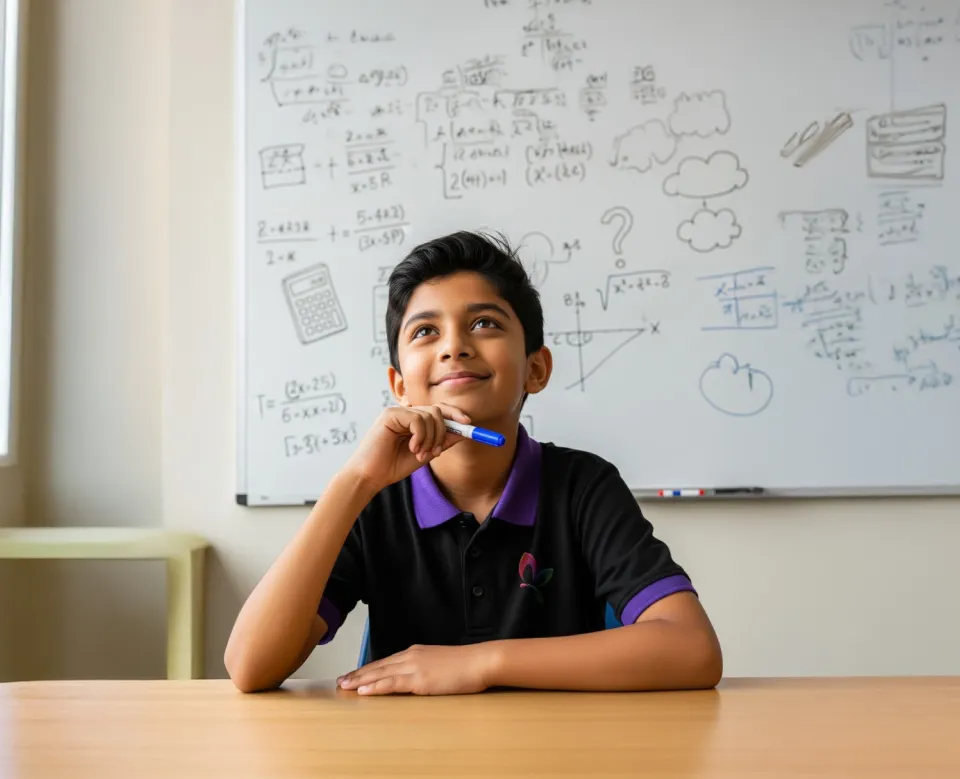
(Grade 3 – 5)

(Age 8 to 10)

1) Languages

Students

  • Develop oracy, reading skills, writing skills, values and dispositions.
  • Develop oral language skills using complex sentence structures to understand and communicate ideas coherently.
  • The ability to read with comprehension by gaining a basic understanding of different forms of familiar and unfamiliar texts (such as prose and poetry).
  • Develop the ability to write simple and compound sentence structures to express their understanding and experiences.
  • Acquire a more comprehensive range of words in various contexts (of home and school experience) through different sources.
  • Develop interest and preferences in reading.

2) Mathematics

Students

  • Develop basic numeracy, mathematical thinking, problem solving, mathematical intuition, joy, curiosity and wonder.
  • Understands number (counting numbers and fractions), represent whole number using the Indian place value system, understand and carriy out the four basic operations with whole numbers, and discover and recognise patterns in number sequences.
  • Analyse the characteristics and properties of two – and three-dimensional geometric shapes, specifiy locations and describe spatial relationships; and recognise and create shapes that have symmetry.
  • Understand measurable attribute of objects and the units, systems and processes of such measurement, including those related to distance, length, weight, area, volume and time using nonstandard and standard units.
  • Develop problem-solving skills with procedural fluency to solve mathematical puzzles as well as daily-life problems, and as a step towards developing computational thinking.
  • Know and appreciate the development in India of the decimal place value system that is used around the world today.

3) EVS

Children develop self–directed learning skills and autonomy. Educators encourage students to set goals and pursue topics of interest, enhancing their responsibility for their learning process.

4)ART EDUCATION

Visual Arts
Students

  • Develop foundational art principles like composition, colour, perspective, light shadow etc.
  • Develop the ability to depict a range of things and ideas in the visual medium using appropriate tools and techniques.
  • Develop a sense of proportion for accurate representation.
  • Develop crucial life skills like creativity, discipline, time management, communication, attention to detail, adaptability, resilience etc.

Theatre
Students

  • Develop confidence to articulate thoughts, feelings and ideas with confidence both verbally and nonverbally.
  • Learn to think critically, collaborate and solve problems together with others.
  • Develop life skills such as self esteem, confidence, empathy, acceptance, adaptability, time management etc.
  • Enhance out of the box thinking and explore new ideas.
  • Develop teamwork, leadership collaboration.

Music
Students

  • Develop confidence to explore and appreciate music and rhythm in their surroundings.
  • Improve recall, concentration and focus.
  • Strengthen analytical skills and logical thinking linking to math concepts like fractions and patterns.
  • Develop hand – eye coordination and balance.

Dance
Students

  • Develop confidence to explore, depict and celebrate human experience appropriately.
  • Develop strength, flexibility, balance, coordination, musicality, rhythm and appropriate posture, expression, focus etc.
  • Explore techniques and exercise their imagination and creativity freely.
  • Explore and develop appreciation and interest in a variety of local art forms and cultural practices.

5) PHYSICAL EDUCATION

Students

  • Demonstrate the use of basic skills (running, jumping, catching, throwing, hitting and kicking) to participate in different physical activities/games/sports.
  • Develop an awareness of their personal and social behaviour towards themselves and others.
  • Demonstrate mental engagement in physical activity/game situations.
  • Understand the need to develop themselves and self-assess their progress.

Middle Stage

(Grade 6 – 8)

(Age 11 to 13)

1) Languages

Students

  • Develop the capacity for effective communication using language skills for description, analysis and response.
  • Appreciate the language, literary and cultural heritage in and related to language by exploring the various forms of literary devices.
  • Develop the ability to recognise linguistic aspects (sentence structure, meaning etc) and use them in oral and written expression.
  • Develop an appreciation of the distinctive features of the particular language, and games unique to the language.
  • Develop functional language skills, literary skills, linguistic skills, art and sports integration in the learning of languages, values and dispositions.
  • Develop the ability to write appropriately in different contexts.
  • Use the Library to find references.

2) Mathematics

Students

  • Master arithmetical operations with whole numbers, fractions and decimals as also order of operations ( BODMAS).
  • Understand the concepts of variable, constant, coefficient, expression and equation and use these concepts to solve meaningful daily-life problems with procedural fluency.
  • Understand, formulate, and apply properties and theorems regarding simple geometric shapes (2D and 3D).
  • Develop understanding of perimeter, area and volume for 2D shapes and use them to solve day-to-day life problems.
  • Understand and apply ratios, rates and proportions; and basic probability concepts.
  • Collect, organise, represent (graphically and in tables), and interpret data/information from daily-life experiences.
  • Develop mathematical thinking and the ability to communicate mathematical ideas logically and precisely.
  • Engage with puzzles and mathematical problems and develop own creative methods and strategies to solve them.
  • Develop basic skills and capacities of computational thinking, namely, decomposition, pattern recognition, data representation, generalisation, abstraction and algorithms in order to solve problems where such techniques of computational thinking are effective.
  • Know and appreciate the development of mathematical ideas over a period of time and the contributions of past and modern mathematicians from India and across the world.
  • Know about and appreciate the interaction of Mathematics with each of their other school subjects.

3) Science

Students

  • Explore the world of matter and its constituents, properties and behaviour.
  • Explore the living and physical world in scientific and mathematical / scientific terms.
  • Develop skills of observation, measurement, inference and prediction, classification, communication, data analysis and hypothesis testing.
  • Perform hands-on experiments, data-driven tasks and inquiry based challenges related to Science.
  • Understand the interface of science, technology and society; apply knowledge and skills appropriately in relevant contexts.
  • Understand and appreciate the contribution of India through history and the present times to the overall field of Science, including the disciplines that constitute it.
  • Develop awareness of the most current discoveries, ideas and frontiers in all areas of scientific knowledge in order to appreciate that Science is ever evolving and that there are still many unanswered questions.

4) Social Studies

Students

  • Develop a basic and adequate understanding of the history, geography, and culture of the locality, region and country; learn responsible participation in a diverse democracy.

    Comprehend and interpret sources related to different aspects of human life and make meaningful interpretations.
  • Explore the process of continuity and change in human civilisations through specific examples from their context and a few historical episodes.
  • Draw connections between the causes and effects of different social and historical events or episodes and connect them with the overall impact on human life.
  • Understand the functioning of social, cultural and political institutions and their impact on society, and the way individuals and collectives shape these institutions.
  • Understand various issues in a society(family, community, regional and national level) and also the initiatives and efforts at various levels to address these issues.
  • Understand the spatial distribution of resources (from local to global), their conservation, the interdependence between natural phenomena and human life, and their environmental and other implications.
  • Appreciate the importance and meaning of being Indian (Bharatiya) by understanding (a) India’s rich past and present including its glorious cultural unity in diversity, pluralism, heritage, traditions, literature, art, architecture, philosophy, medicine, science and other contributions to humanity, and (b) other integrating factors despite the geographical diversity of India.
  • Understand and appreciate the process of development of the Constitution of India and uphold its importance to promote democratic values in Indian society.
  • Understand the processes of economic activities (production and consumption, trade and commerce).
  • Understand and appreciate the contributions of India through history and in the present times, to the overall field of Social Science, including the different disciplines that constitute it.

5) ART EDUCATION

VISUAL ART
Students

  • Learn techniques ( drawing, sketching, painting, colour theory, perspective, etc.).
  • Develop openness to explore and express themselves through various Art and craft forms (work with clay, paper, textiles, create collages, use recycled materials etc.).
  • Perform hands-on activities that involve designing , creating and reflecting; move from basic to complex mixed media projects.
  • Apply their imagination and creativity to explore alternative ideas through the Arts.
  • Acquaint themselves with a range of aesthetic sensibilities and cultural practices.
  • Appreciate the diverse richness of Indian art and craft, learn and adopt local / regional art and craft forms and create works of aesthetic appeal.

THEATRE
Students

  • Learn foundational acting skills (using voice, body, emotion) to communicate a wide range of human experiences artistically.
  • Understand and apply artistic elements, processes and techniques.
  • Apply their imagination and creativity to explore alternative ideas through the Arts.
  • Develop voice and speech with clarity, use space effectively, understand characters, express emotions, interpret dialogue, understand the subtext etc.)
  • Develop creative and technical skills like improvisation and devising; storytelling etc.
  • Develop knowledge and understanding of basic lighting, sound, props, set-design, practical problem solving etc.
  • Develop life skills like confidence, creativity, communication, collaboration
  • Appreciate and acquaint themselves with the rich diversity of aesthetic theatre art forms of India.

MUSIC
Students

  • Develop knowledge, understanding and foundational skills in musical elements such as rhythm, pitch, melody, harmony etc.
  • Develop active listening skills, build reading fluency and comprehension; reading and writing basic musical notations.
  • Develop vocal and instrumental proficiency’
  • Apply their imagination and creativity to explore alternative ideas through improvisation and composition.
  • Develop life skills like memorisation, discipline,confidence, communication, collaboration, problem solving etc.
  • Appreciate and acquaint themselves with the rich diversity of musical forms in India and elsewhere since ancient times.

Dance
Students

  • Develop essential knowledge and understanding of body awareness, posture, balance, coordination, rhythm; expressive movement incorporating steps ( bend, stretch, rise etc.); elements like space and energy.
  • Develop coordination and timing; strength and stamina; flexibility and mobility; coordination and timing; balance and weight transfer etc.
  • Apply their imagination and creativity to explore alternative ideas through dance
  • Develop life skills like discipline, focus, creativity, teamwork etc.
  • Appreciate and acquaint themselves with the rich diversity of dance forms in India and elsewhere since ancient times.

6) PHYSICAL EDUCATION

Students

  • Enhance fundamental skills like running, jumping, throwing, catching, balancing, kicking, striking etc.
  • Develop their understanding and improve agility, speed, power, coordination and reaction time.
  • Demonstrate body movements and motor skills to participate in different physical activities/games/sports.
  • Develop life skills like responsibility, teamwork, confidence, resilience, problem solving etc.
  • Learn the connection between physical activity with health, enjoyment, challenge, expression and social interaction.
  • Exhibit sensitivity in their personal and social behaviour towards themselves and others.
  • Plan and achieve personal physical fitness goals with little help from teachers.
  • Appreciate and familiarise themselves with the rich diversity of physical sports in India and elsewhere since ancient times.

6) PHYSICAL EDUCATION

  • Demonstrates intermediate body movements and motor skills to participate in different physical activities/games/sports and develop their understanding.
  • Exhibits sensitivity in their personal and social behaviour towards themselves and others.
  • Demonstrates and practises physical movements, motor skills, social sensitivity, and mental engagement in physical activity/game situations.
  • Plans and achieves personal physical fitness goals with little help from Teachers.
  • Learns the connection between physical activity with health, enjoyment, challenge, expression, and social interaction.

Pedagogy across
the stages

• Learning Through Story Telling
• Toy based learning
• Songs and Rhymes
• Music and Dance
• Art & Craft
• Indoor & Outdoor games
• Nature Time
• Field Trips
Learning
across different stages

• Rootedness in India. Indian knowledge system.
• Character building.
• Learning about and caring about environment.
• Developing sensitive to the less privileged.
• Using technology appropriately in different context.

LANGUAGE CLUB

The club aims to provide a supportive, informal environment for students to develop language skills, build confidence and foster an appreciation for diverse cultures.

HORTICULTURE

Students engage in hands-on gardening activities, learning about plants, food production and the environment—while also promoting healthy eating habits and teamwork.

FINANCIAL LITERACY

Mirai aims to build strong financial literacy through responsible and smarter money management and daily decision-making.

THEATRE & ART

Integrating theatre and art into the school curriculum offers benefits far beyond creative expression—it supports holistic student development and enhances a wide range of essential life skills.

LIFE SKILLS

Embedding life skills into the curriculum is vital for equipping students with the practical, emotional and social tools needed to navigate the challenges of modern life.

A Learning Culture That Lasts

Mirai Academics is not limited to classrooms, worksheets, or outcomes. It is a culture — one that values depth over speed, thought over repetition, and understanding over performance.

Here, children don’t just learn.
They discover who they are as learners.

Frequently Asked Questions

What is the teaching philosophy at Mirai?

Mirai follows a mindful, child-centered philosophy where learning unfolds through observation, reflection and expression. We focus on helping children think independently, communicate clearly and grow at their natural pace. We value depth of understanding over speed or performance.

What sets Mirai apart is our belief that every children learn best when they feel seen and respected. We follow a child-centred, mindful approach that supports independent thinking, clear communication and steady, meaningful progress—without pressure or comparison.

At Mirai, teachers carefully observe each child to understand their strengths, interests and learning rhythm. Our low teacher–student ratios—2:20 in Pre-Primary and 1:25 in Primary—allow educators to provide personalised guidance adapt lessons thoughtfully and ensure every child progresses with confidence at their own pace.

At Mirai, parent communication is open, respectful and ongoing. Teachers share insightful observations about each child’s learning and growth, focusing on understanding, well-being and progress over time. We believe strong partnerships with families support children best.

What age group does Mirai cater to?

Mirai offers programmes for children in the Foundational, Preparatory and Middle Stages, supporting learners from the early years through key foundational and developmental phases of their education.

Each day at Mirai balances academics, creative expression and sports. Children engage in meaningful classroom learning as well as age-appropriate physical activities that promote coordination confidence and healthy habits. The day is thoughtfully paced to support deep learning without pressure.

Yes. Age-appropriate homework will reinforce whatever is learned at school. Opportunities will be provided for exploring activities and projects in a mindful, not burdensome way.

enquire now